
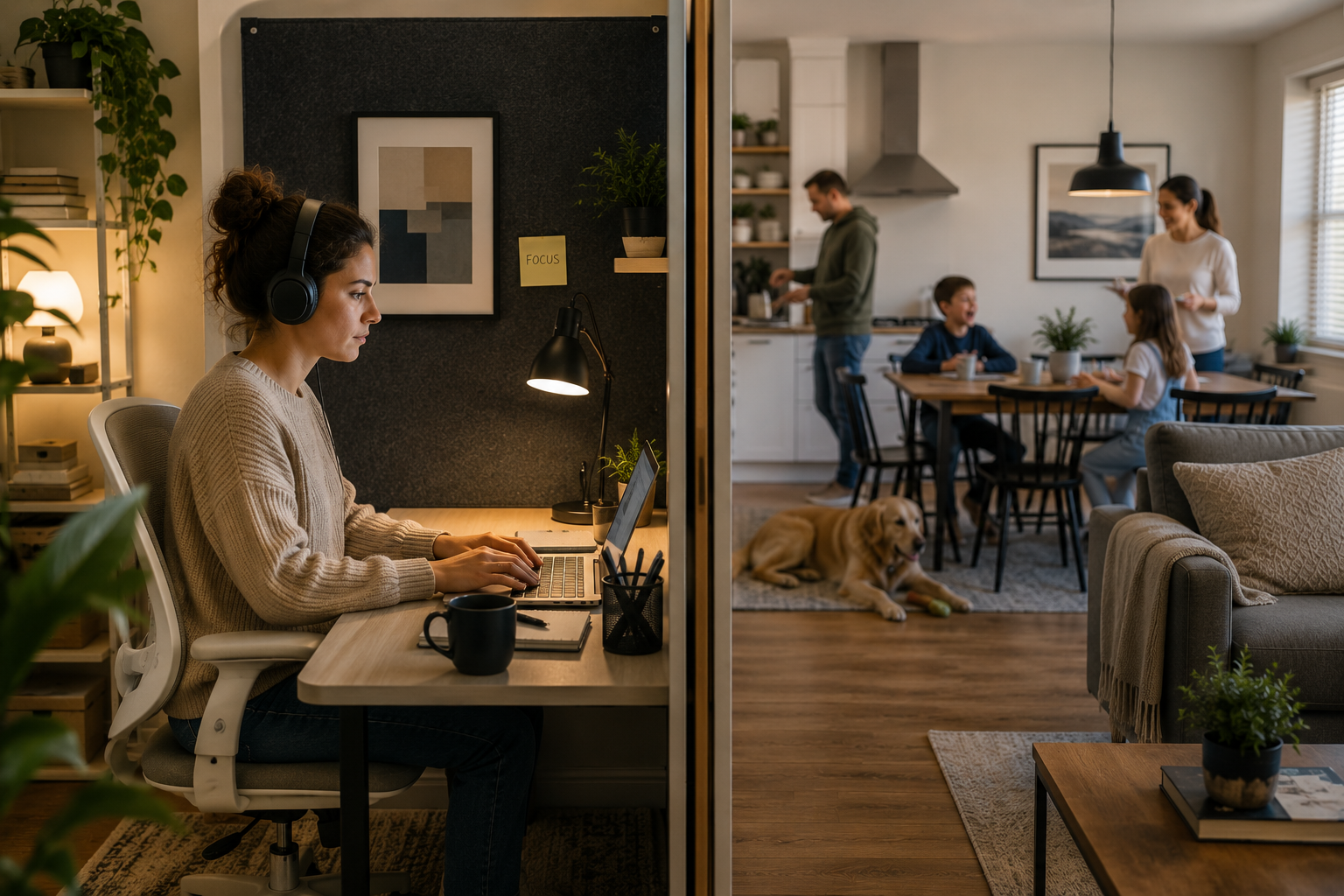
Your roommate walks through the living room singing along to a podcast. Your partner starts unloading the dishwasher during your 2 PM standup. The dog barks at the mail carrier exactly when you are trying to write the opening paragraph of a report. You do not have a home office. You have a corner of a shared space that everyone else treats as part of the house. And somehow, you are expected to produce focused work there.
This is the reality for millions of people who work from home in shared apartments, small houses, or multi-generational households. The problem is not motivation. It is an environment. Your brain cannot enter deep work mode when the space around it signals “living room” instead of “workspace.” The solution is not to build walls. It is to create a focus zone — a clearly defined area that functions as a mental and physical boundary between your work and the rest of the household.
What a Focus Zone Actually Is
A focus zone is not a room. It is a commitment. It is a specific area, however small, that you and the people you live with agree is off-limits during work hours. The agreement matters more than the square footage. A focus zone can be a desk in a bedroom corner, a folding table in a hallway, or even a specific chair at the dining table that no one sits in between 9 AM and 5 PM.
The key is that the zone has rules. When you are in it, you are working. When someone else enters it, they are interrupting. This clarity prevents the constant micro-interruptions that fragment attention and make deep work impossible. Research on distraction-free workspaces confirms that dedicated, clutter-free areas signal focus to your brain and reduce household interruptions.
Without a defined zone, every work session becomes a negotiation. Your brain stays in a low-level alert state, listening for footsteps, monitoring for interruptions, never fully committing to the task at hand. Over a full workday, this vigilance exhausts you more than the actual work does.
Step 1: Claim the Space
Start with what you have. Do not wait for a spare room to open up. Look for the least trafficked area in your home and designate it. Upstairs corners are often better than ground-level spaces because they are farther from street noise and foot traffic. If your only option is the dining table, choose the seat that faces a wall rather than the kitchen, and declare that seat as your workstation during specific hours.
The physical boundaries can be minimal. A folding screen, a bookshelf placed perpendicular to the wall, or even a curtain on a tension rod can create enough visual separation to signal “work zone” to the rest of the household. The goal is not soundproofing. It is visual demarcation. When your partner sees the screen, they remember the agreement. When you see it, your brain shifts into work mode.
The Corner Office Mindset
If you are working from a corner of a shared room, orient your desk so your back faces the wall and your screen faces the corner. This positioning reduces visual distractions from the rest of the room and prevents people from walking behind you, which is both distracting and a privacy concern during video calls. Positioning your workspace perpendicular to windows also reduces glare on your screen.
The 5-Minute Space Audit
Walk through your home and identify every spot where you could place a desk or table. Rate each spot on three criteria: foot traffic (1-5), noise level (1-5), and natural light availability (1-5). The spot with the lowest combined traffic and noise score is your focus zone, even if the light is poor. You can add a lamp. You cannot add silence to a hallway.
Step 2: Set the Rules
The most effective focus zones fail not because of space but because of unclear boundaries. You need a system that everyone in the household understands and respects. This system does not have to be formal, but it does have to be explicit.
Start with a simple signal. A closed door means “do not enter unless the house is on fire.” “Headphones on” means “I am in focus mode; text me instead of talking.” A specific desk lamp turned on means “work hours are active.” The signal must be visual and immediate, not something that requires other people to check a schedule or remember your calendar.
Communicate your work hours clearly, but also communicate your break times. If your household knows you take lunch at 12:30, they will wait for that window instead of interrupting you at 12:15. If they know you finish at 5 PM, they will hold non-urgent conversations until then. The boundary works both ways—when you are out of the zone, you are fully present. When you are in it, you are fully working.
Handling the Hard Conversations
Not everyone will respect the zone immediately. Children, in particular, struggle with abstract boundaries. Make the zone physical for them. A piece of tape on the floor around your chair creates a “magic circle” that they can see and understand. A small whiteboard next to your desk with a red/green card lets them check your status without asking.
For adult household members, frame the boundary as mutual benefit. “When I finish this report by 3 PM, I can help with dinner. If I get interrupted, I am still working at 6.” This reframes the focus zone as a time-saver for everyone, not a selfish demand for silence.
Step 3: Control the Inputs
A focus zone is only as good as the sensory information entering it. Visual clutter, noise, and temperature fluctuations all pull your brain out of deep work. Address these systematically.
Visual Control
Your desk should hold only what you need for the current task. Not what you might need later. Not what you used this morning. The current task only. This “one task surface” rule prevents your eyes from wandering to unfinished projects or unrelated items.
Store everything else in drawers, boxes, or a nearby shelf. If you do not have drawers, use a storage ottoman or a plastic bin that slides under your desk. The physical act of putting items away signals to your brain that those tasks are parked, not abandoned, which reduces the anxiety that open loops create.
Color matters. Blue and green walls promote focus and calm. Yellow can spark creativity, but it becomes overwhelming in large doses. If you cannot paint, hang a blue or green tapestry behind your desk. Even a colored poster in your peripheral vision can shift your mental state.
Auditory Control
Noise-canceling headphones are the single most effective tool for focus zones in shared homes. They block household noise and signal to others that you are unavailable. Even if you do not play music, wearing them creates a psychological barrier that reduces interruptions by 40% or more in most households.
If headphones are not an option, a white noise machine or a fan placed between you and the rest of the room masks speech frequencies without adding distracting content. The goal is not silence—which is impossible in most homes—but consistent, predictable sound that your brain can filter out automatically.
Temperature and Air
A workspace that is too warm induces drowsiness. Too cold causes tension and frequent breaks to fetch layers. The ideal range is 20 to 22 degrees Celsius (68 to 72 Fahrenheit). If your focus zone is near a window that gets direct sun, add a blind or reposition your desk to avoid the afternoon heat. Good ventilation matters too — stale air reduces cognitive performance by up to 15% in enclosed spaces.
The Input Checklist
- Desk cleared to current task only
- Storage system within arm’s reach for everything else
- Noise control active (headphones, white noise, or fan)
- Temperature between 20-22°C with fresh air circulation
- Lighting: natural light supplemented by task lamp, no glare on screen
Step 4: Build the Ritual
Spaces become associated with activities through repetition. Your bed is for sleep because you have slept there hundreds of times. Your focus zone will only work if you use it consistently and ritualize the transition into work mode.
Create a start-of-work ritual that takes 60 seconds. It could be making coffee, opening the laptop, putting on headphones, and writing today’s top three priorities on a sticky note. The sequence matters less than the consistency. Over two weeks, your brain will begin associating the first action in the sequence with the mental state that follows.
End-of-work rituals are equally important. Close the laptop. Put the headphones away. Clear the desk surface. If you are using a shared space like the dining table, physically pack up your work materials and store them out of sight. This action tells your brain that work is finished and tells your household that the space is shared again. Without this boundary, work bleeds into evening hours and the focus zone loses its meaning.
Step 5: Handle the Shared Space Reality
Most focus zone advice assumes you have a dedicated room. In reality, you probably share your workspace with laundry, meals, and family life. Here is how to manage the most common shared space scenarios.
| Scenario | Immediate Fix | Long-Term Fix |
|---|---|---|
| Bedroom desk, partner sleeps in | Use noise-canceling headphones; dim screen brightness | Relocate desk to face wall, not bed; add room divider |
| Living room, constant foot traffic | Position desk in corner, back to wall; use visual signal | Folding screen or bookshelf barrier; negotiate quiet hours |
| Dining table, meals overlap with work | Portable bin for work materials; clear table completely at meals | Wall-mounted fold-down desk in adjacent hallway or corner |
| Kitchen counter, cooking noise | Work during non-cooking hours only; use headphones | Relocate to any other available space; kitchen is last resort |
| Two people working in same room | Back-to-back desk arrangement; both use headphones | Sound blanket hung between desks; staggered call schedules |
When the Zone Breaks Down
Some days, the focus zone will fail. Construction starts outside. A child is homesick. Your partner has an important call at the same time you do. These are not failures of the system. They are exceptions that require temporary adjustments.
Have a backup location identified in advance. It could be a coffee shop, a library study room, or even your car parked in a quiet lot. Knowing you have an escape option reduces the stress of a disrupted workspace and prevents you from trying to power through an environment that is genuinely incompatible with focus.
Also, build flexibility into your schedule. If you know your household is loudest in the late afternoon, schedule administrative tasks—email, scheduling, and light reading—for that window and reserve mornings for deep work. Fighting the household’s natural rhythm is exhausting. Working with it is sustainable.
The Real Measure of Success
A focus zone is working when you stop thinking about it. When the boundary becomes automatic, when household members no longer test it, when your brain shifts into work mode the moment you enter the space—that is when you know the system has taken hold. Until then, keep reinforcing the rules. Consistency over perfection is what builds the habit.
Related Articles
- Why Desk Height Causes Wrist Pain During Long Calls
- How to Position a Monitor to Stop Daily Neck Strain
- Background Noise Ruins Video Calls and This Helps
- Why Cheap Chairs Hurt Your Posture More Than You Think
- Easy Ways to Store Papers Without a Filing Cabinet
- How to Set Boundaries When Family Shares Your Workspace
- Common Reasons Video Lighting Looks Unprofessional at Home
Sources and References
- HP Tech Takes. “Distraction-Free Home Office Setup Tips.” April 29, 2026. https://www.hp.com/hk-en/shop/tech-takes/post/distraction-free-home-office-setup-tips
- Medium. “How to Create a Distraction-Free Work Environment.” January 10, 2025. https://medium.com/@arijitgoswami/how-to-create-a-distraction-free-work-environment-02120ab1f4ff
- Home World Design. “Designing a Distraction-Free Work-From-Home Environment.” April 24, 2025. https://homeworlddesign.com/designing-a-distraction-free-work-from-home-environment/
- Quora. “How do you create a distraction-free workspace in a noisy household?” https://www.quora.com/How-do-you-create-a-distraction-free-workspace-in-a-noisy-household

Elena Rodriguez is a certified home inspector and DIY educator specializing in maintenance routines, home repairs, decor optimization, office setup, and smart device integration. She helps homeowners tackle projects with confidence using tools they already own. Her writing focuses on actionable steps for cleaning, fixing, arranging, and automating. Elena holds a degree in Construction Management and contributes to home improvement resources regularly.