
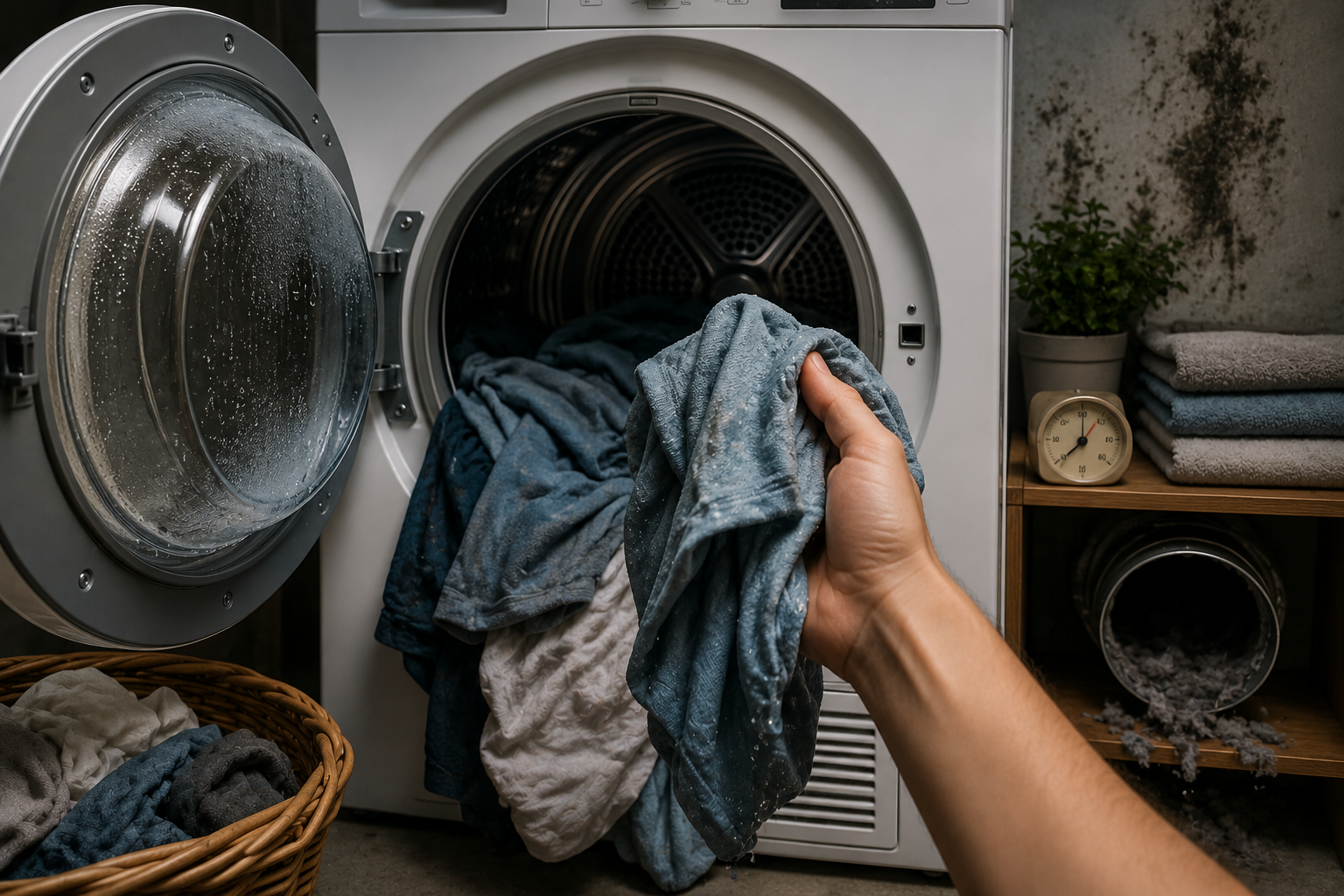
You pull the warm clothes from the dryer and start folding. The towels feel dry. The sheets feel dry. But your t-shirt is damp in the armpits. Your jeans are damp at the waistband. The socks are damp at the toes. The dryer ran its full cycle. The lint trap is clean. The settings were correct. Yet somehow, the clothes are not uniformly dry. This is one of the most frustrating laundry experiences because it defies logic — a machine that gets most things right while failing on specific items in the same load.
The problem is rarely the dryer itself. Dryers are simple machines that blow hot air through tumbling clothes until moisture evaporates. When clothes come out damp after a full cycle, the cause is usually one of five predictable factors that interrupt this basic process. Understanding which factor is affecting your load lets you fix the problem without calling a repair technician or buying a new appliance.
Reason 1: Overloading
This is the most common cause and the easiest to fix. A dryer works by tumbling clothes through a stream of hot air. When the drum is too full, the clothes form a solid mass that the air cannot penetrate. The outer layers get dry while the inner core remains damp. When you pull the load out, the damp clothes are the ones that were buried in the center, shielded from airflow by the dry clothes around them.
The capacity rule is simple: fill the dryer drum to about two-thirds full. The clothes should tumble freely, falling and separating as they rotate. If the drum is packed so tightly that clothes stick together in a ball, the load is too large. A standard dryer handles about 12 to 15 pounds of wet laundry. A large-capacity dryer handles up to 20 pounds. Exceeding these limits guarantees uneven drying.
Overloading also strains the dryer mechanically. The motor works harder to turn a heavy drum. The belt wears faster. The bearings heat up. And the damp clothes that require a second cycle double your energy consumption. The dryer that “never dries right” is often just a dryer that is consistently overloaded. Reduce the load size and the problem disappears.
Reason 2: Mixed Fabric Types
Different fabrics absorb and release moisture at different rates. Cotton is highly absorbent and releases moisture quickly. Polyester is less absorbent but traps moisture in its fibers. Denim is dense and slow to dry. Athletic wear with synthetic blends wicks moisture but holds it in the fabric structure. When you combine these materials in a single load, the dryer finishes when the sensor detects that the average moisture level is low — which means the fast-drying fabrics are over-dried while the slow-drying fabrics remain damp.
The fix is to sort by fabric weight and drying speed, not just by color. Heavy items — jeans, towels, sweatshirts — belong in one load. Lightweight items — t-shirts, underwear, dress shirts — belong in another. Athletic wear with moisture-wicking properties often needs a separate cycle on low heat. When fabrics with similar drying characteristics tumble together, the sensor accurately reflects the state of the entire load, and everything finishes at the same time.
Denim deserves special attention. A single pair of jeans can hold enough moisture to make a mixed load feel damp. If you consistently find damp waistbands and seams, dry jeans separately or in a small dedicated load. The thick seams and pockets act as moisture reservoirs that standard cycles struggle to fully evaporate.
The Hand Test
When the dryer cycle ends, reach into the center of the load and pull out a middle item. If it is significantly damper than the outer items, you have an airflow problem caused by overloading or poor tumbling. If the dampness is scattered randomly throughout the load, you have a mixed-fabric problem. If everything feels slightly damp, you have a heat or ventilation problem.
Reason 3: Clogged Ventilation
A dryer needs to exhaust moist air to remove the water it is evaporating from your clothes. If the exhaust vent is blocked, the moist air has nowhere to go. It circulates back into the drum, re-humidifying the clothes as fast as the heat dries them. The result is a load that tumbles for an hour and finishes exactly as damp as it started.
Vent blockages come from three sources. Lint accumulation is the most common. Even with a clean lint trap, fine particles escape into the exhaust duct and build up over time. The exterior vent hood is the second culprit — birds nest in it, leaves clog it, and the flapper mechanism can stick closed. The third is duct kinking or crushing, which happens when the dryer is pushed too close to the wall and the flexible duct bends sharply, restricting airflow.
Check the exterior vent while the dryer is running. You should feel a strong, warm stream of air exiting the hood. If the airflow is weak or barely warm, the duct is partially blocked. Disconnect the duct from the dryer and vacuum it out, or use a dryer vent cleaning kit with a brush and flexible rods that reach through the entire length. Clean the vent at least once a year. Homes with heavy laundry use may need cleaning every six months. A clogged vent is also a fire hazard — lint is highly flammable, and the heat from restricted airflow can ignite it.
Reason 4: Sensor Malfunction
Modern dryers use moisture sensors to determine when clothes are dry. These sensors are typically metal strips inside the drum that detect electrical resistance across damp fabric. When the resistance drops below a threshold, the dryer assumes the clothes are dry and shuts off. The system works well when the sensors are clean and the clothes are tumbling properly. It fails when the sensors are coated with residue or when the fabric does not contact the sensors consistently.
Fabric softener and dryer sheets are the hidden enemies of moisture sensors. These products leave a waxy film on the sensor strips that insulates them from the fabric. The dryer cannot detect moisture accurately, so it either shuts off too early — leaving clothes damp — or runs too long — wasting energy and over-drying. The fix is to wipe the sensor strips with a damp cloth and a drop of rubbing alcohol every month. This removes the residue and restores accurate readings.
Some dryers use thermistors instead of contact sensors. These measure air temperature and estimate dryness based on how quickly the air is heating up. Thermistors can drift out of calibration over time, causing the dryer to misjudge moisture levels. If your dryer consistently under-dries or over-dries despite correct loading and clean vents, a technician can recalibrate or replace the thermistor. This is a $50 to $100 repair, not a reason to replace the appliance.
Reason 5: Washer Spin Speed Issues
Sometimes the problem is not the dryer at all. It is the washing machine. If the washer does not spin properly, the clothes enter the dryer saturated with water instead of merely damp. A standard dryer is designed to remove moisture from damp clothes, not to extract water from soaking wet fabric. The extra water load overwhelms the dryer’s capacity, and the cycle ends before evaporation is complete.
Signs that the washer is the real culprit include clothes that are dripping wet when transferred to the dryer, a washer drum that does not spin at high speed during the final cycle, or an unbalanced washer that aborts the spin cycle early. Check the washer’s spin setting — many have options from gentle to extra-high. For heavy fabrics, use the highest spin speed the fabric care label allows. This removes up to 50% more water before drying, cutting dryer time and energy use significantly.
An unbalanced washer drum is another common cause. When the load is uneven, the washer stops the spin cycle to prevent damage, leaving clothes much wetter than intended. Redistribute the load evenly around the drum and restart the spin cycle. If the washer consistently fails to balance, the suspension rods may be worn and need replacement.
| Symptom Pattern | Most Likely Cause | Quick Fix |
|---|---|---|
| Center items damp, outer items dry | Overloading | Reduce load to two-thirds capacity |
| Heavy fabrics damp, light fabrics dry | Mixed fabric types | Sort by weight and dry separately |
| Everything slightly damp, cycle seems short | Clogged vent or sensor residue | Clean vent and wipe sensor strips |
| Everything very damp, extra-long cycle needed | Washer spin failure | Check washer spin cycle and balance |
| Intermittent dampness, no clear pattern | Sensor calibration drift | Service call for thermistor recalibration |
When to Call a Professional
Some dryer problems require expertise beyond DIY troubleshooting. If you have addressed loading, sorting, vent cleaning, and sensor maintenance and the dryer still underperforms, the issue may be internal. A failing heating element produces warm air that is not hot enough to evaporate moisture efficiently. A broken belt causes the drum to tumble intermittently, leaving clothes in contact with hot metal instead of moving through the airflow. A faulty thermostat shuts off the heat prematurely to prevent overheating, but in doing so prevents adequate drying.
These repairs are straightforward for a technician and typically cost $100 to $300. They are not reasons to replace a dryer that is otherwise functional. A ten-year-old dryer with a new heating element will outlast a budget replacement with inferior build quality. The key is accurate diagnosis. Throwing money at a new appliance when a $50 part would fix the old one is wasteful and unnecessary.
Prevention: The Load That Dries Right Every Time
The perfect dryer load is not luck. It is preparation. Shake each item before transferring it from washer to dryer. Clothes that are twisted or balled up dry unevenly because the inner folds trap moisture. Shaking them open exposes all surfaces to airflow. Do not cram the transfer. Drop clothes loosely into the drum, one at a time, so they tumble freely from the start.
Clean the lint trap before every load. A full lint trap restricts airflow by up to 75%, which is the equivalent of a partially clogged vent. The trap takes five seconds to clean. The energy savings and drying efficiency are immediate. If you use dryer sheets, clean the lint trap with warm water and a soft brush monthly. The waxy residue from the sheets coats the mesh and reduces airflow even when the trap looks empty.
Choose the right cycle for the load. High heat for towels and jeans. Medium heat for synthetics and permanent press. Low heat or air fluff for delicates and athletic wear. The auto-dry setting works best when the load is uniform and the sensors are clean. For mixed loads, use timed dry with manual checking. The extra attention prevents the frustration of pulling out damp clothes when you thought the cycle was finished.
The Bottom Line
Damp clothes after a full cycle are not a mystery. They are a message. The message is that something in your laundry process is interrupting the basic physics of heat, airflow, and evaporation. Listen to the symptom, match it to the cause, and fix the process. The dryer that “never works right” is usually just waiting for you to load it correctly, clean its vent, or wipe its sensors. The solution is already in your hands.
Related Articles
- Why Grout Darkens Even After Regular Mopping
- How to Clean Gutters Safely Without a Tall Ladder
- Refrigerator Coils Collect Dust and Raise Your Bill
- Simple Guide to Washing Machine Care for Longer Use
- Easy Ways to Remove Hard Water Marks From Glass
- Why Garbage Disposals Smell and How to Freshen Them
- How to Clean Air Vents Without Spreading Dust Around
Sources and References
- Consumer Reports. “How to Clean Your Dryer Vent.” 2025. https://www.consumerreports.org/appliances/clothes-dryers/how-to-clean-your-dryer-vent-a1072332418/
- Mr. Appliance. “Why Is My Dryer Not Drying?” 2025. https://www.mrappliance.com/expert-tips/why-is-my-dryer-not-drying/
- Sears Home Services. “Why Your Dryer Takes Too Long to Dry.” 2025. https://www.searshomeservices.com/blog/why-your-dryer-takes-too-long-to-dry
- Repair Clinic. “Dryer Not Drying? 6 Troubleshooting Tips.” 2025. https://www.repairclinic.com/blog/dryer-not-drying-6-troubleshooting-tips
- Appliance Repair Specialists. “Why Is My Dryer Not Drying Clothes?” 2025. https://www.appliancerepairspecialists.com/blog/why-is-my-dryer-not-drying-clothes
- Home Depot. “How to Clean a Dryer Vent.” 2025. https://www.homedepot.com/c/ab/how-to-clean-a-dryer-vent/9ba683603be9fa5395fab9012396e63
- Family Handyman. “Dryer Vent Cleaning.” 2025. https://www.familyhandyman.com/project/clean-your-dryer-vent/

Elena Rodriguez is a certified home inspector and DIY educator specializing in maintenance routines, home repairs, decor optimization, office setup, and smart device integration. She helps homeowners tackle projects with confidence using tools they already own. Her writing focuses on actionable steps for cleaning, fixing, arranging, and automating. Elena holds a degree in Construction Management and contributes to home improvement resources regularly.