
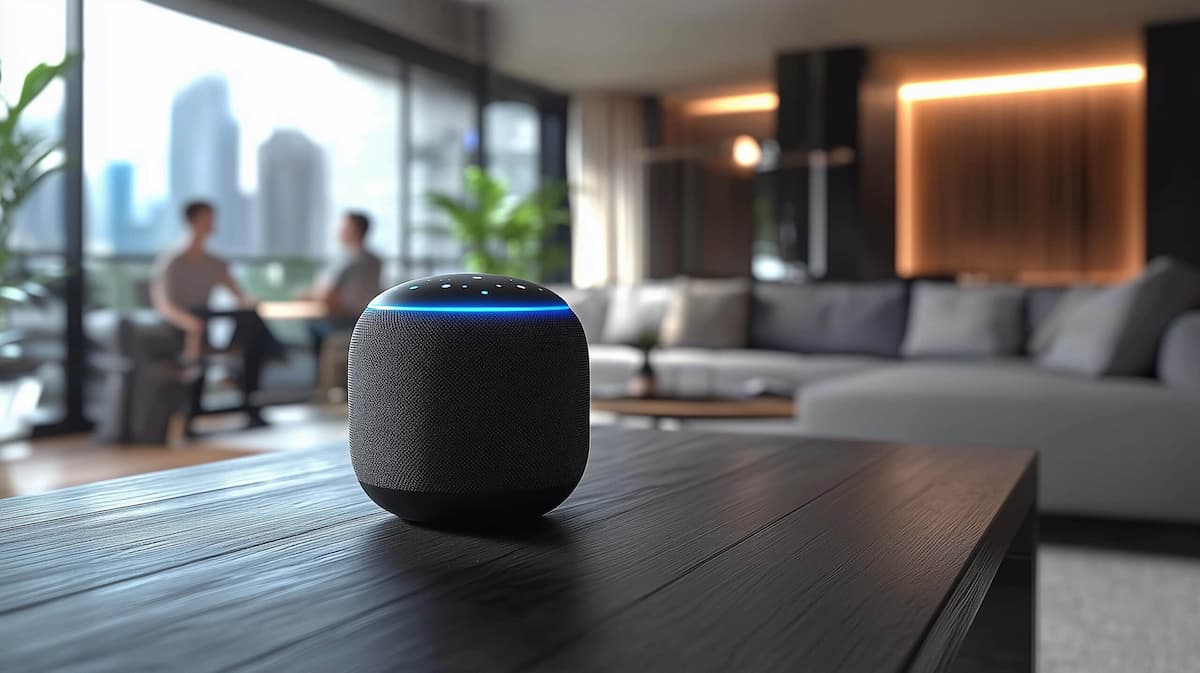
However, in larger spaces, many homeowners encounter other problems. A voice assistant that works well in a bedroom or office may suddenly stop responding in an open-plan living room, a spacious family room, or a room with a high ceiling. You may have to repeat commands, receive inaccurate answers, or even receive no response at all.
It is easy to assume that the device itself is defective, but the problem often lies in the environment, not with the assistant. Large spaces present acoustic challenges, making speech recognition more difficult. By understanding these obstacles, homeowners can improve performance without having to replace the device.
Large Spaces Change the Way Sound Propagates:
Voice assistants rely on microphones to receive speech clearly. In a small space, your voice travels quickly and directly to the device. This means that the chance of sound distortion before the microphone is smaller, making speech recognition more reliable.
In a large space, sound propagates differently. Sound energy has to travel greater distances to reach a device, and energy is lost during transmission. The greater the distance, the weaker the signal the voice assistant receives, making it more difficult to recognise your voice and distinguish it from background noise.
To humans, this loss of sound quality may be imperceptible. However, speech recognition systems require accurate audio information. Even subtle differences in clarity can affect the correct interpretation of commands.
Echoes Disrupt Speech Recognition Systems:
Echoes are one of the most common problems in large spaces. When sound waves hit walls, ceilings, floors, and furniture, they bounce back into the room. In large, open spaces, these echoes often linger longer, causing the same sound to reach the device at different times. The human brain is quite capable of ignoring echoes in a conversation. However, voice assistants rely on algorithms to extract speech patterns. Excessive reflections make it difficult for the system to distinguish between the original commands and the delayed reflections.
This is particularly noticeable in rooms with wooden floors, tiled walls, large windows, and minimal furniture. These materials reflect sound well, increasing the likelihood of errors in speech recognition.
High Ceilings also Pose a Challenge:
Many modern homes feature vaulted or high ceilings to make rooms appear spacious and bright. While these designs are aesthetically pleasing, they can create a less-than-ideal acoustic environment for voice assistants.
Higher ceilings mean more space for sound to spread. At the same time, they also increase the surface area that reflects sound. Sound waves reflect repeatedly in the room and eventually weaken. Therefore, microphones can pick up a mix of direct speech and reflected sound simultaneously. In other homes, residents reported that voice assistants worked well when they were nearby, but that performance declined significantly when commands were given from across the room. This is largely due to higher ambient noise levels.
Background Noise has a Greater Impact in Large Spaces:
Large spaces are often multifunctional. Open-plan rooms can combine a living room, kitchen, dining room, and entertainment corner. Such an arrangement generates a significant amount of background noise, which can hinder speech recognition.
Televisions, dishwashers, air conditioning, ceiling fans, conversations, and kitchen appliances all influence the overall acoustic environment. While people can usually focus on a speaker’s voice in a noisy room, voice assistants must be able to isolate commands from all other distracting noise sources.
As background noise increases, devices may struggle to distinguish between speech and ambient noise. This can lead to slow response times, operating errors, or even a complete failure to recognise commands.
Device Placement is More Important Than Most People Think:
A common mistake homeowners make is placing voice assistants haphazardly near power outlets. While such positioning is convenient, this placement may not create an ideal acoustic environment.
A voice assistant placed on a bookshelf, in a corner, or next to a television, for example, may not receive voice commands properly. Corners amplify sound reflections, and background noise from nearby electronic devices can affect microphone performance.
In larger spaces, device placement becomes even more important, as devices must be able to bridge greater distances and navigate more complex acoustic environments. Placing the assistant in a convenient location often improves overall responsiveness.
Open Floor Plans Create More Complex Acoustic Environments:
Open floor plans are popular because they offer flexible living spaces and make more efficient use of natural light. From an acoustic perspective, however, this layout can pose unique obstacles to voice-controlled devices.
Without walls to delineate different activity zones, sounds from different directions mix, creating a uniform sound. A voice assistant can hear conversations in the kitchen, music in the dining room, and the television in the living room.
The device must then distinguish whether the sound heard is a specific instruction or the sound of everyday household activities. This additional processing can reduce the accuracy of recognition, especially when the instruction comes from a distance.
Limitations of Microphone Arrays:
Modern voice assistants are typically equipped with a large number of different microphones. These microphones are designed to determine the direction of incoming sound, thereby improving the accuracy of recognition. Often, they perform excellently.
However, microphone technology is not without flaws. Even larger spaces and more complex acoustic environments affect advanced microphone arrays. In some cases, distance, echoes, and background noise can prevent the system from correctly extracting speech.
Therefore, technology that performs well in a small office can sometimes encounter problems in a large, open living space. The technology itself is capable, but the environment has a major influence on performance in practice.
Multiple Voice Assistants Can Be More Useful:
Many homeowners think that the only option is to upgrade to a more expensive voice assistant. But in reality, adding an extra device in a suitable location can be better than replacing an old one.
Many large families have multiple voice assistants in different locations in frequently used rooms. This helps bridge the gap between users and devices, allowing users to easily receive commands without having to speak.
Nowadays, various smart home ecosystems enable different devices to work together. This improves ease of use and ensures consistency in the control of the entire house.
Soft Furnishings Improve Speech Recognition Accuracy:
A simple way to improve the efficiency of voice assistants is by reducing excessive sound reflections. Soft materials absorb sound energy and help reduce echoes, thereby improving speech recognition accuracy.
Carpets, curtains, upholstered furniture, cushions, and fabric wall coverings can all contribute to a more balanced acoustic environment. People often choose these items for comfort or aesthetics, but they also make voice commands easier to understand.
If a room is very echoey, adding sound-absorbing materials can often help. Sometimes, small adjustments can significantly improve a device’s response speed.
Network Problems Are Not Always the Culprit:
When a voice assistant fails to understand a command, many people first suspect a problem with the network connection. Network problems can indeed lead to longer response times and issues with cloud processing, but the connection is usually not the root cause of recognition issues.
If your device repeatedly fails to understand your commands, the problem likely occurs before the audio uploads to the network. Poor acoustics, distance, or excessive ambient noise sometimes cause recognition issues rather than network performance issues.
Understanding this distinction can help homeowners find practical solutions instead of upgrading network equipment unnecessarily.
Conclusion
Voice assistants are designed to simplify your daily tasks, but their effectiveness depends on the environment. Larger spaces are more complex: sound travels further, echoes are stronger, and background noise is amplified more quickly.
A voice assistant’s ability to understand commands can depend on factors such as room size, ceiling height, an open layout, device placement, and the acoustic environment. The positive news is that most of these issues can be resolved by optimising device placement, increasing the number of devices, and making simple adjustments to the room itself.
Once homeowners understand why voice assistants do not perform well in larger spaces, they can adjust the environment to make these devices work better and achieve the intended convenience.
Frequently Asked Questions
Why does my voice assistant perform better in a smaller room?
Generally, smaller rooms have fewer acoustic issues, shorter speaking distances, and less interference from echoes and background noise.
Will my voice assistant perform better if I move it?
Yes. In general, moving the device to a more central location, away from corners, televisions, and other sound sources, can improve speech recognition.
Do carpets and curtains really help voice assistants hear better?
Yes, they can. Soft materials absorb sound reflections and reduce echoes, allowing the microphone to pick up voice commands more accurately.
Is it necessary to add a second voice assistant if the room is large?
Occasionally it is better to place a new device near the most frequently used location to improve a voice assistant’s performance rather than replacing the existing device.
Sources & References
- Consumer Technology Association (CTA)
- Acoustical Society of America (ASA)
- National Institute of Standards and Technology (NIST)
- Smart speaker and voice assistant manufacturer technical documentation
- Research on speech recognition and room acoustics
Related Articles

Elena Rodriguez is a certified home inspector and DIY educator specializing in maintenance routines, home repairs, decor optimization, office setup, and smart device integration. She helps homeowners tackle projects with confidence using tools they already own. Her writing focuses on actionable steps for cleaning, fixing, arranging, and automating. Elena holds a degree in Construction Management and contributes to home improvement resources regularly.